
Tyre Shop Near Me: Everything You Need to Know Before You Go
Introduction: That Moment You Realise You Need a Tyre Shop
We’ve all been there. You walk out to your car on a Tuesday morning, coffee in hand, already running five minutes late — and there it is. A flat tyre. Or maybe you’ve been ignoring that faint wobble in the steering wheel for a few weeks, telling yourself it’s probably nothing. Either way, you suddenly find yourself typing “tyre shop near me” into Google and hoping for the best.
Finding a reliable tyre shop doesn’t have to be stressful. Whether you need a quick puncture repair, a full set of new tyres, or just an honest second opinion, knowing what to look for makes the whole process a lot easier. This guide is going to walk you through everything — from how to spot a good local tyre shop to understanding what all those numbers on the side of your tyre actually mean.
Let’s get into it.
Why It Matters Where You Get Your Tyres Done
Your tyres are the only part of your car that actually touches the road. Every single thing your car does — braking, turning, accelerating — relies entirely on four patches of rubber roughly the size of your hand. That’s not a lot of contact area, which is why the quality of your tyres and the competence of whoever fits them really does matter.
A bad tyre job doesn’t just cost you money. It can affect your fuel economy, wear out your suspension faster, and in the worst cases, it becomes a genuine safety issue. So while it might be tempting to just go to whoever is cheapest or closest, it pays to spend a few minutes choosing properly.
How to Find a Good Tyre Shop Near You
- Start With Google — But Don’t Stop There
Typing “tyre shop near me” into Google is the obvious first step, and it works well enough to give you a starting list. But the results you see first are often based on who has paid for better visibility, not necessarily who is best. So once you have your list, take a moment to do the following:
Check the reviews properly. Don’t just look at the star rating — read what people actually say. Look for comments about how staff explained things, whether the price matched the quote, and how long the job took. A shop with 4.3 stars and 200 genuine reviews is usually more trustworthy than one with 5 stars and six reviews.
Look at how they respond to complaints. Every business gets the odd bad review. What tells you more about a business is how they handle it. A professional response that addresses the concern calmly is a good sign. Defensive or dismissive replies are a red flag.
- Ask Around
This one sounds old-fashioned, but it still works. Ask your colleagues, neighbours, or friends where they take their car. Word of mouth is hard to fake, and if someone you trust says “I’ve used them for years and they’ve never done me wrong,” that counts for a lot.
- Look for Accreditations
In the UK, look out for garages that are members of the National Tyre Distributors Association (NTDA) or that are RAC or AA approved. These aren’t guarantees of perfection, but they do mean the business has agreed to a code of conduct, which is reassuring.
- Ring Them Before You Go
A quick phone call tells you a lot. Are they friendly? Do they answer your questions without making you feel like an idiot? Do they give you a clear price over the phone? If they’re cagey about pricing before you’ve even arrived, that’s worth noting.
What Services Does a Tyre Shop Offer?
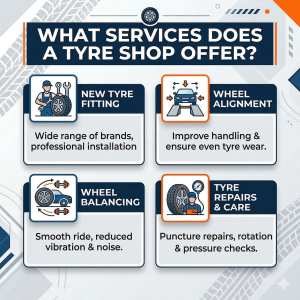
Most people think of tyre shops as purely a place to buy new rubber, but a decent local tyre shop will offer quite a few services:
Tyre fitting and balancing — This is the main one. They’ll mount new tyres onto your wheels and balance them so there’s no vibration at speed.
Puncture repairs — If your tyre has a nail or screw in the tread area and the damage is repairable, a good shop will fix it rather than push you to buy a new tyre. Repairs are usually quick and cost very little.
Wheel alignment (tracking) — If your car pulls to one side or your tyres are wearing unevenly, you likely need an alignment check. Poorly aligned wheels chew through tyres surprisingly fast.
TPMS (Tyre Pressure Monitoring System) services — Many modern cars have sensors in the wheels that alert you when pressure drops. If these need resetting or replacing, a good tyre shop will handle it.
Seasonal tyre swaps — If you run winter and summer tyres separately (which is sensible if you live somewhere with harsh winters), many shops offer a swap-and-store service.
Tyre inspections — If you’re not sure whether your tyres need replacing, a quick inspection can give you a proper answer rather than a guess.
How to Know When You Actually Need New Tyres
This is one of the most common questions people have, and it’s worth answering properly.
The Legal Minimum Tread Depth
In the UK, the legal minimum tread depth for car tyres is 1.6mm across the central three-quarters of the tyre, around the full circumference. Go below that and you’re looking at a fine of up to £2,500 per tyre and three penalty points on your licence.
But here’s the thing — most tyre professionals recommend replacing tyres at 3mm, not 1.6mm. The difference in stopping distance between 3mm and 1.6mm in wet conditions is significant. It’s not just about staying legal; it’s about staying safe.
The 20p Test
A simple way to check your tread at home: take a 20p coin and push it into the main tread grooves. If the outer band of the coin disappears, your tread is above the legal limit. If you can see the whole outer band, you need to get those tyres checked — or replaced — soon.
Other Signs You Need New Tyres
Beyond tread depth, keep an eye out for:
- Cracks or bulges in the sidewall — These can indicate internal damage and are serious. Don’t drive on a tyre with a visible bulge.
- Vibration at speed — Could be balance, but can also mean the tyre structure has deteriorated.
- Tyres older than five to seven years — Even if the tread looks fine, rubber degrades over time. Check the DOT code on the sidewall to find out when the tyre was made.
- Persistent loss of pressure — If you’re topping up the same tyre regularly, there’s something wrong.
Understanding Tyre Sizes: What Those Numbers Mean
When you ring a tyre shop, they’ll ask for your tyre size. You’ll find it on the sidewall of your current tyre, and it looks something like this: 205/55 R16 91V.
Here’s what each part means:
- 205 — The width of the tyre in millimetres
- 55 — The aspect ratio (the height of the tyre’s sidewall as a percentage of its width)
- R — Radial construction (almost all modern car tyres are radial)
- 16 — The wheel diameter in inches
- 91 — The load index (how much weight the tyre can carry)
- V — The speed rating (in this case, up to 149mph)
You don’t need to memorise all of this. Just find the number on your tyre’s sidewall and either have it ready when you ring the shop, or let them check it when you arrive.
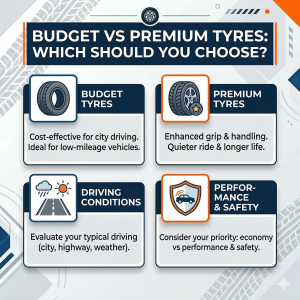
Budget vs Premium Tyres: Which Should You Choose?
This is the question that causes more debate in tyre shops than almost anything else. The honest answer is: it depends on how much you drive, what kind of car you have, and what you use it for.
Premium brands (Michelin, Bridgestone, Continental, Pirelli, Goodyear) generally offer the best performance in wet conditions, the most consistent handling, and tend to last longer. If you cover a lot of miles or drive on motorways regularly, the extra cost is usually worth it in the long run.
Mid-range brands (Falken, Hankook, Kumho, Cooper) offer a solid middle ground. They perform well in most conditions and won’t cost you as much as premium tyres. For most ordinary drivers, these represent good value.
Budget brands vary considerably in quality. Some are perfectly fine for low-mileage city driving. Others cut corners in ways that affect wet-weather grip. Be cautious, and always check independent test results if you’re considering a brand you’ve never heard of.
One last thing: don’t be pressured into buying tyres on the day. A good tyre shop will give you time to think, check prices elsewhere, and come back. If anyone is being pushy, that’s a sign to walk away.
Questions to Ask Your Tyre Shop
Before you agree to any work, it’s completely reasonable to ask:
- Is this tyre repairable, or does it genuinely need replacing?
- What brands do you stock in my size, and what’s the price difference?
- Does the price include fitting, balancing, and valve replacement?
- Will you check the tyre pressure and reset my TPMS?
- How long will it take?
A reputable tyre shop will answer all of these without hesitation. If someone seems irritated by your questions, take that as a sign.
Mobile Tyre Fitting: Is It Worth It?
Mobile tyre fitters have become much more popular over the last few years. They come to your home or workplace, fit your tyres on the drive or in the car park, and save you the trip to a garage.
For the right situation, it’s genuinely convenient — especially if you’ve had a flat and can’t safely drive anywhere. The prices are usually competitive, and the work is done to the same standard as a shop.
The trade-off is that they don’t always carry as wide a range of tyres, and if something unexpected comes up (like a worn wheel bearing they notice while the wheel is off), they can’t deal with it on the spot the way a full garage can.
How to Get the Best Deal at a Tyre Shop
Nobody wants to pay more than they have to. Here are a few straightforward ways to keep costs down without cutting corners on safety:
Compare quotes online first. Sites like Blackcircles and mytyres let you search by tyre size, compare prices, and often book fitting at a local garage at the same time. It takes about ten minutes and can save you a fair bit.
Don’t automatically go for the cheapest. As mentioned above, budget tyres vary in quality. A tyre that costs £20 less but wears out sooner, or performs poorly in the rain, isn’t actually a saving.
Ask about part-worn tyres carefully. Part-worn tyres are legal and can save money, but quality is highly variable. If you go this route, make sure the tyre has adequate tread depth, no sidewall damage, and a reputable fitting history. A trustworthy shop will be transparent about where part-worns have come from.
Book mid-week if you can. Some shops are less busy on weekday mornings, which means quicker service and occasionally more flexibility on price.
Frequently Asked Questions
Q: How do I find the best tyre shop near me? Start with a Google search and check reviews, but also ask friends or family for recommendations. Look for shops with lots of genuine reviews, clear pricing, and membership of a recognised trade body like the NTDA.
Q: Can a flat tyre always be repaired? Not always. Punctures in the central tread area can usually be repaired, but damage to the sidewall, a large tear, or a tyre that has been driven on while flat generally can’t be safely fixed. A good tyre shop will tell you honestly whether repair is an option.
Q: How long does tyre fitting take? For a single tyre, usually 20–30 minutes. A full set of four tyres with balancing typically takes 45–90 minutes, depending on how busy the shop is.
Q: Should I replace tyres in pairs or all four at once? Ideally, replace tyres in pairs — both front or both rear — to keep handling balanced. If your budget allows, replacing all four at once ensures consistent performance across the car. At the very least, never replace just one tyre on a driven axle.
Q: What is wheel alignment and do I need it? Wheel alignment (or tracking) ensures your wheels are pointing in the right direction relative to each other and to the road. If your car pulls to one side, your steering wheel is off-centre, or your tyres are wearing unevenly, you probably need an alignment check. It’s relatively inexpensive and can save your tyres from wearing out prematurely.
Q: Are run-flat tyres worth it? Run-flat tyres allow you to keep driving at reduced speed after a puncture, which can be useful. However, they’re more expensive, can’t usually be repaired after a puncture, and give a slightly harsher ride. They’re worth considering if your car doesn’t have a spare tyre and you drive in areas where getting a puncture would be particularly inconvenient.
Q: How often should I check my tyre pressure? Once a month and before any long journey is a sensible habit. Under-inflated tyres wear faster, use more fuel, and handle poorly. Most petrol stations have air pumps, and many are free to use. Your car’s correct tyre pressures are usually printed on a sticker inside the driver’s door or in your handbook.
Q: Can I drive on a spare tyre for long? If it’s a full-size spare, yes — though you should still get the original tyre sorted promptly. If it’s a space-saver (the narrow “skinny spare”), it’s only designed for short distances at reduced speeds. Check your handbook for the specific limits, but as a rule of thumb, get it replaced as soon as you reasonably can.
Q: How do I know if a tyre shop is trustworthy? Look for transparent pricing, genuine online reviews, willingness to answer your questions, and professional accreditations. A trustworthy shop will never pressure you into buying something you don’t need and will clearly explain what work is required and why.
Q: What should I do if I get a puncture while driving? If you feel a sudden change in handling or hear a flapping noise, ease off the accelerator gently and steer to a safe area. Don’t brake sharply. Switch on your hazard lights, pull as far off the road as possible, and call for assistance if you don’t feel confident changing the tyre yourself. Never change a tyre on a motorway hard shoulder — move to the nearest service station if you can.
Final Thoughts
Finding a good tyre shop near you isn’t complicated, but it does take a little bit of effort. Read the reviews, ring ahead, ask sensible questions, and don’t let anyone rush you into a decision you’re not comfortable with.
Your tyres are too important to hand over to just anyone. But with the information in this guide, you’re well-placed to find a local tyre shop that’s honest, competent, and fairly priced — and to walk in knowing what you’re talking about.
Whether you need a quick puncture patch or a full set of new rubber, a good local tyre shop will make the whole experience straightforward and stress-free. And once you find one you trust, it’s worth going back to them every time.